
I have officially finished taught classes at OICPS and moved to London (for five weeks) to leap once again into the world of publishing. Week one: a sales and marketing internship with Hot Key Books. I was offered the internship back in December, first approaching Sarah Benton, head of marketing, through Twitter, and then following up by emailing my covering letter and C.V. to them. I had met Sarah again whilst volunteering at London Book Fair, and was amazed to realise that yes, my ridiculously dedicated *ahem* use of Twitter to keep up with book news was genuinely beneficial. Hot Key Books run an internship scheme around the year, giving individuals interested in working in publishing the chance to train with them, and working with Creative Access and Lift and Platform to further outreach.
To afford the trip I’m staying with my uncle, aunt, cousins and a large golden retriever called Ruby, as they graciously offered me their spare room for the duration of my work placements, with Hot Key Books providing travel expenses cover of £35. My journey to work is just a quick hop on the Northern line and a walk down the road to Hot Key’s office. I settled in to a café around the corner early each morning for a cappuccino and the chance to read.
The Hot Key office is in a lovely converted building, with open plan floors and shelves full of beautiful books. You get a real sense of the exciting energy that the young publishing house has to offer. If you have been following my blog for a while you already know that I’m pretty much head over heels for their wonderful list of middle grade and teen titles, so I was positively floating to be working for them. I was greeted on Monday morning by Naomi Colthurst, editorial assistant. She introduced me to everyone and set me to work reading manuscripts (I can’t tell you what I’m afraid!) to the musical accompaniment of David Bowie’s Space Oddity beaming down from space courtesy of Chris Hadfield.
The most incredible thing about being an intern, aside from the chance to put all those skills you’ve stacked up over the year to use at last, is the chance to observe how things are done out in the real world. Every publishing house is unique. Seeing how each department interacts with each other at Hot Key Books reinforced the feeling that this is a publishing house that works as a team, sharing ideas to create the best books they possibly can offer. Collaboration, imagination and innovation are the keys to success.
I saw the culmination of Fleur Hitchcock's Story Adventure, a term long project of interactive online creative writing with primary school children, as it came to an end ready for the final book to be put together.
On Wednesday it was publication day (book birthday) for Natalie Whipple’s Transparent about a world where high school superpowers are the norm. This meant that there was much fun to be had watching the tweets roll in from people (and dogs) in various states of invisibility. The marketing department embraced the theme, with Livs Mead dressing up a coat rack and flying headphones held by totally not visible hands, Sarah Benton opening filing cabinets out of sight, and Cait Davies working on emails with eyes in the back of her head. Hot Key really understand that the best way to promote their titles is to revel in the fun. Books, after all, are a source of entertainment.
I was lucky enough on Thursday to meet Debbie McCune, author of Death & Co., after a successful day of reading and workshops with schools. I’d spent some time the previous day reading her book, a brilliant novel about a boy who inherits the role of teen grim reaper from his family. Great for fans of Supernatural, Dead Like Me, and Grimm! My task was to locate character descriptions for an illustrator’s competition run by Movella. Find out more (and the character quotations!) here.
I also spent the week reading and analysing Friday Brown by Vikki Wakefield. This book was originally published in Australia, and will be published in the UK on the 4th July. Proofs are making their way around to bookshops and bloggers. I will be reviewing it for MuggleNet a little closer to the launch date, but for now I shall say that it is a truly remarkable book, thought provoking, brave, bold and emotional. The twists and turns make you question ideas and beliefs you hold, challenging perceptions and the power of truth versus fiction. I challenge you not to fall in love with the character of Silence. If you’ve read Red Ink or Maggot Moon, then definitely pick up Friday Brown, as it offers another breath taking literary journey.
The quality of their titles can be seen today, with both Sally Gardner’s Maggot Moon and Lydia Syson’s A World Between Us longlisted in the nominations for the Guardians’ Children’s Prize 2013.
My week with Hot Key Books was a whirlwind of tasks and triumphs, and discovering that, yes, I am really very interested in pursuing a career in publishing and marketing/publicity. I was allowed to read, practice copy-editing, and research. If I could have I would have stayed for as long as they'd have me. But the week flew by, and for now I am off to internship number two, a month with Headline Publishing Group.
Thank you, Hot Key, for letting me come and watch you guys in action! And I cannot wait to read these great proofs and new releases. First up is Transparent.
To afford the trip I’m staying with my uncle, aunt, cousins and a large golden retriever called Ruby, as they graciously offered me their spare room for the duration of my work placements, with Hot Key Books providing travel expenses cover of £35. My journey to work is just a quick hop on the Northern line and a walk down the road to Hot Key’s office. I settled in to a café around the corner early each morning for a cappuccino and the chance to read.
The Hot Key office is in a lovely converted building, with open plan floors and shelves full of beautiful books. You get a real sense of the exciting energy that the young publishing house has to offer. If you have been following my blog for a while you already know that I’m pretty much head over heels for their wonderful list of middle grade and teen titles, so I was positively floating to be working for them. I was greeted on Monday morning by Naomi Colthurst, editorial assistant. She introduced me to everyone and set me to work reading manuscripts (I can’t tell you what I’m afraid!) to the musical accompaniment of David Bowie’s Space Oddity beaming down from space courtesy of Chris Hadfield.
The most incredible thing about being an intern, aside from the chance to put all those skills you’ve stacked up over the year to use at last, is the chance to observe how things are done out in the real world. Every publishing house is unique. Seeing how each department interacts with each other at Hot Key Books reinforced the feeling that this is a publishing house that works as a team, sharing ideas to create the best books they possibly can offer. Collaboration, imagination and innovation are the keys to success.
I saw the culmination of Fleur Hitchcock's Story Adventure, a term long project of interactive online creative writing with primary school children, as it came to an end ready for the final book to be put together.
On Wednesday it was publication day (book birthday) for Natalie Whipple’s Transparent about a world where high school superpowers are the norm. This meant that there was much fun to be had watching the tweets roll in from people (and dogs) in various states of invisibility. The marketing department embraced the theme, with Livs Mead dressing up a coat rack and flying headphones held by totally not visible hands, Sarah Benton opening filing cabinets out of sight, and Cait Davies working on emails with eyes in the back of her head. Hot Key really understand that the best way to promote their titles is to revel in the fun. Books, after all, are a source of entertainment.
I was lucky enough on Thursday to meet Debbie McCune, author of Death & Co., after a successful day of reading and workshops with schools. I’d spent some time the previous day reading her book, a brilliant novel about a boy who inherits the role of teen grim reaper from his family. Great for fans of Supernatural, Dead Like Me, and Grimm! My task was to locate character descriptions for an illustrator’s competition run by Movella. Find out more (and the character quotations!) here.
I also spent the week reading and analysing Friday Brown by Vikki Wakefield. This book was originally published in Australia, and will be published in the UK on the 4th July. Proofs are making their way around to bookshops and bloggers. I will be reviewing it for MuggleNet a little closer to the launch date, but for now I shall say that it is a truly remarkable book, thought provoking, brave, bold and emotional. The twists and turns make you question ideas and beliefs you hold, challenging perceptions and the power of truth versus fiction. I challenge you not to fall in love with the character of Silence. If you’ve read Red Ink or Maggot Moon, then definitely pick up Friday Brown, as it offers another breath taking literary journey.
The quality of their titles can be seen today, with both Sally Gardner’s Maggot Moon and Lydia Syson’s A World Between Us longlisted in the nominations for the Guardians’ Children’s Prize 2013.
My week with Hot Key Books was a whirlwind of tasks and triumphs, and discovering that, yes, I am really very interested in pursuing a career in publishing and marketing/publicity. I was allowed to read, practice copy-editing, and research. If I could have I would have stayed for as long as they'd have me. But the week flew by, and for now I am off to internship number two, a month with Headline Publishing Group.
Thank you, Hot Key, for letting me come and watch you guys in action! And I cannot wait to read these great proofs and new releases. First up is Transparent.
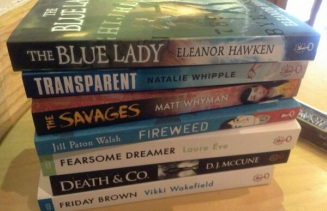 Hot Key Books! |  Coffee is important! |




 RSS Feed
